
When continents collide
Geology in the Middle Rhine Valley
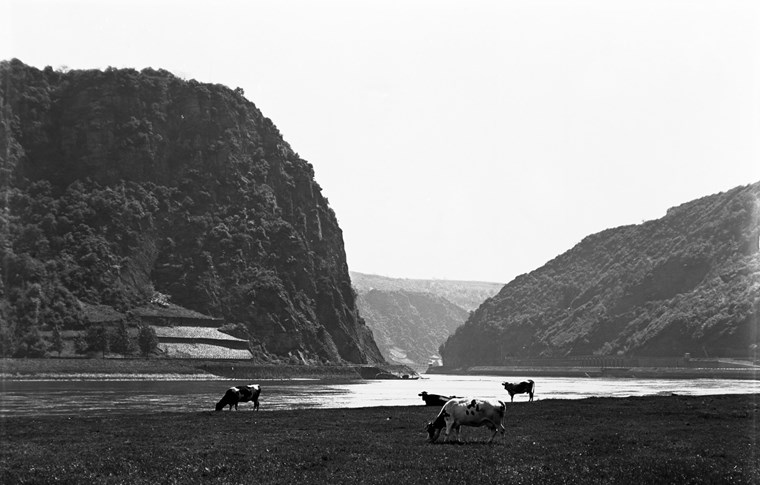 The rocks of the Upper Middle Rhine Valley consist mainly of the sand, silt and clay of ancient continents.
Around 400 million years ago, during the Devonian period, these materials were deposited in vast quantities at the bottom of a shallow sea. Under the weight of the overlying sediments they were gradually consolidated into rock. Near the coast, sandstone was formed from deposits of sand. The lighter clay particles were carried further out to sea and later solidified into mudrocks.
Around 340 million years ago, during the Carboniferous period, opposing movements of the Earth's tectonic plates caused the continents to collide. The rock layers beneath the seabed were folded and eventually pushed on top of each other.
Under pressure, the sandstones turned into hard quartzite, while the mudrocks evolved into dark slate which flakes off in thin layers. Eventually, the rock layers were thrust up above sea level forming the Rhenish Massif.
Around 15 million years ago, the Proto-Rhine flowed across the low hilly landscape in a wide valley. In its bedload, it carried pebbles of various colours and sizes. Increasingly intense movements of the Earth's crust over the last 700,000 years have forced the Rhine to cut deeply into the uplifting mountains, right up to the present day. This has created the distinctive landscape of the Middle Rhine Valley. Hence, pebbles can also be found roughly 150 metres above the current valley floor on the plateaus overlooking the valley.
The slate in particular constitutes a special habitat. Under the sun’s rays, the dark rock can heat up to temperatures exceeding 70° Celsius. One unique feature, which only grows on the slate debris of the Middle Rhine Valley, is the Boppard candytuft flower.


