
Nocturnal aerial acrobats
Bats
 At the Binger Loch, the combined effects of man and nature have lead to the evolution of a wide variety of habitats which coexist side by side and are home to an extraordinary diversity of species. 9 of the 25 species of bat found in Germany have been identified within the Mäuseturm Park.
For us humans they usually go unnoticed during the day. But as dusk falls, the bats take to the skies in pursuit of insects. They are the only mammals that can actively fly. For this purpose they have thin flight membranes that are stretched between their wrists, ankles and tail. They orientate themselves by emitting ultrasonic waves that are inaudible to the human ear and by interpreting the reflected echoes.
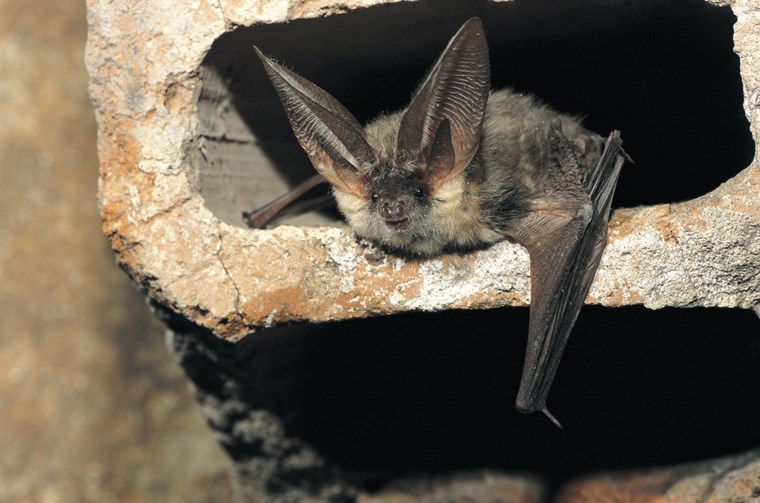
A bat's annual cycle is marked by changes in roost locations and habitats. As many as 4,000 females raise their young in communal maternity roosts. The mating season begins in August, and the bats start to swarm. At this time of year the mating calls of male Nathusius’ pipistrelle bats echo through the park. They also start looking for suitable frost-free hibernation sites. Many bat species roost in buildings, as well as in rock crevices, tunnels and tree hollows. When most bat species are already fast asleep, long-eared bats can still be seen hunting winter moths in the park.
The most common visitor to the park is the common pipistrelle, one of the smallest bat species. In the twilight of the blue hour, you can marvel at their acrobatic, zig-zagging flight patterns, as they loop and abruptly change direction all along the hedges and treetops.


